Forensic Disability in Australasia - News Roundup
A roundup of legal and policy developments, research, sector news, a positive spotlight, and upcoming professional development relevant to forensic disability and complex forensic/mental health needs across Australia and New Zealand. This first edition looks back roughly three months to help readers catch up; later editions will cover the preceding month.
Content note: this edition discusses findings of coercive and unlawful treatment of people with intellectual disability in a New Zealand forensic ward, described in general, non-graphic terms. Readers with lived experience of institutional care may want to prepare for that before reading on.
Legal, Policy & Systemic Reviews
Barriers Within Bars — first national report on First Nations people with disability in the justice system
National Disability Research Partnership, with the University of Melbourne's BlakAbility team (A/Prof Sheelagh Daniels-Mayes, Dr Sharon Kerr, Dr Aunty Roslyn Sackley) · released 2 September 2026, presented at the National Indigenous Black Deaths in Custody Conference, Brisbane
Described as the first national, Indigenous disability-led research examining the experiences of Aboriginal and Torres Strait Islander people with disability in Australia's criminal justice system. Drawing on interviews with people with lived experience of incarceration, family members, legal professionals and academics — alongside a review of the existing literature (which found only 18 of 177 relevant studies actually addressed this intersection) — the report documents disability going undiagnosed or unsupported due to cost and culturally unsafe health services, behaviour being criminalised rather than met with appropriate support, and compounding disadvantage from bail through to incarceration and re-entry. It's a significant evidence base for AAFDI members working at the intersection of disability, culture and justice.
Link: https://www.ndrp.org.au/report-barriers-within-bars
Queensland Public Advocate: The Queensland Forensic System (Mental Health and Disability) — discussion paper
Office of the Public Advocate (Queensland) · discussion paper, 18 July 2025
A systemic review of Queensland's forensic system for people with mental illness and cognitive/intellectual disability, raising concerns including fitness-for-trial tests that don't adequately account for available supports, indefinite detention with no fixed time limit, fragmented governance across agencies, inappropriate placement of people with intellectual disability in mental health facilities, and use of seclusion and restraint. It discusses Treatment Support Orders (TSOs) — the step-down mechanism from a Forensic Order that allows treatment in the community with reduced oversight — and argues for better transition planning and community support so people can actually move onto and succeed under a TSO rather than remaining on more restrictive orders longer than necessary. The Public Advocate followed this up in March 2026 with a further discussion paper proposing a full review of the Mental Health Act itself.
Link: https://www.justice.qld.gov.au/__data/assets/pdf_file/0003/848451/20250718-forensic-system-final.pdf
NSW parliamentary inquiry into the forensic division of the Mental Health Review Tribunal holds hearings
NSW Parliament — Committee on Law and Safety · Hearings held 10–11 August 2026
The Committee on Law and Safety is examining the operations of the forensic division of the NSW Mental Health Review Tribunal, including its case-management approach and the effect of recent legislative change. The self-referred inquiry follows sustained advocacy after the death of Biddy Porter, whose family's #Justice4BiddyPorter petition — signed by more than 20,000 people — called for greater transparency and accountability in forensic patient reviews. The Committee has said it is examining systemic process issues rather than revisiting individual Tribunal decisions; a report is expected following the August hearings.
Source: Inquiry details — NSW Parliament
Aotearoa New Zealand commits NZ$35 million to expand forensic mental health services
Beehive.govt.nz (NZ Government) · announced 15 July 2026
Budget 2026 funding will add four new forensic inpatient beds (two at Auckland's Mason Clinic, two in Porirua), six community step-down beds to support people transitioning out of inpatient care, and more prison mental health and court liaison staff to connect people with appropriate support earlier. New beds are expected to open between January and March 2027.
Source: Faster access to forensic mental health support — Beehive.govt.nz
Ombudsman finds coercive and unlawful treatment in a Dunedin forensic intellectual disability ward; Health NZ begins closing it
Health NZ / Chief Ombudsman (NZ) · reported from 3 July 2026
An Ombudsman investigation identified coercive and unlawful treatment practices, and flagged potential human rights concerns, in Ward 10A at Wakari Hospital in Dunedin, a forensic intellectual disability ward. Health NZ has confirmed the findings, begun closing the ward, and commissioned an independent review of practice; further reporting is expected as that review continues. It's a live reminder of why independent oversight and workforce practice standards in forensic disability settings matter.
Source: RNZ coverage — Ombudsman findings at Wakari Hospital
Psychologists warn a new NDIS assessment tool risks unreliable, high-stakes decisions for complex clients
Australian Psychological Society, via The Weekly Times · 31 August 2026
The Australian Government plans to roll out an adapted version of the I-CAN assessment tool from April 2027 to help determine NDIS funding levels, using a three-hour interview and algorithm-based scoring. The APS and independent researchers have raised concerns about the tool's reliability and validity for such a high-stakes purpose, warning that imprecision could mean both wasted funding and real harm to participants — a concern directly relevant to people with complex psychosocial and forensic disability support needs.
Source: APS in the Weekly Times — NDIS assessment tool
Research & Papers
New population-linkage study on disability support after prison release (NSW)
Hwang et al. (2026) · Journal of Intellectual Disability Research
“Predictors of Receiving Disability Support Services After Release From Prison in Adults With Intellectual Disability: A Population-Based Linkage Study From New South Wales, Australia” examines which factors predict whether people with intellectual disability access disability support services after leaving custody, building on the UNSW 3DN group's ongoing work on justice transitions. The full findings sit behind the journal paywall, so specific predictors aren't summarised here — worth requesting the PDF for a closer read.
Source: Hwang et al. (2026), DOI: 10.1111/jir.70058
Practice pointers on supporting neurodivergent patients in forensic mental health wards (NZ)
Foster (2026) · Kōtuitui: New Zealand Journal of Social Sciences Online
“Neurodivergent Patients in Forensic Mental Health Wards: Practice Pointers From a Scoping Study” draws on a scoping study to offer practical, identity-affirming guidance for clinicians and support staff working with neurodivergent people in forensic mental health settings.
Source: Foster (2026), DOI: 10.1002/kot2.70006
New systematic review flags data gaps on forensic mental health prevalence in Australia
Psychiatry, Psychology and Law (2026) · published online ahead of print
A newly published systematic review audits the available Australian data — and the gaps in it — on the prevalence of adults who require forensic mental health care, covering the same complex-needs population AAFDI members work with across mental health and disability systems. The abstract is paywalled, so treat this as a pointer to follow up on rather than a summary of findings.
Source: DOI: 10.1080/13218719.2026.2624848
Positive Spotlight
Forensicare's Lived Experience Workforce is an established, structural program employing people with personal experience of the mental health and justice systems as peer workers, consumer consultants, family/carer consultants, and — at senior level — a Director of Lived Experience, across its prison, hospital and community services. It's a concrete example of lived-experience leadership built into how a forensic mental health service actually runs.
Source: Lived Experience Workforce — Forensicare
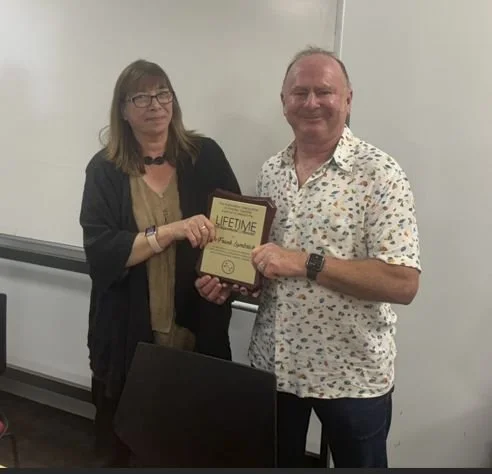
AAFDI Lifetime Achievement Award (2024) - Dr Frank Lambrick
AAFDI are very pleased to announce that the inaugural winner for the Lifetime Achievement Award 2024 went to Dr Frank Lambrick. Congratulations Frank!
The Lifetime Achievement award was introduced to recognise extraordinary contributions to forensic disability. The field is relatively newly recognised as an area of specialised practice and has evolved significantly over the past few decades. There has been little in the way of recognition and appreciation for those who have worked tirelessly to advance practice and policy for individuals with disability involved in the criminal justice system.
While many dedicated professionals collaborating and contributing to the field deserve to be recognised, we can only give one Lifetime Achievement Award. Our recipient for 2024 is widely recognised as having been an early pioneer of what we know as ‘forensic disability’ today, Dr Frank Lambrick is known and loved within the sector for his decades of dedication, innovation and passionate advocacy for forensic disability consumers. His achievements span across research, clinical practice and policy.
Beginning in the 1980’s, Dr Lambrick has worked tirelessly with individuals as a practitioner and as an academic who made significant contributions to specialised risk assessment and clinical treatment and later supported the sector as a whole as a Senior Practitioner in Victoria until his retirement.
Today, he continues educating practitioners and sector workers and continues to strive for ever improving services for forensic disability consumers. He has spearheaded significant reform in the use of restrictive practices. Decades of practitioners have been mentored and shaped by his work, and he has advanced forensic disability profoundly.
Dr Lambrick has therefore been selected to receive this first ever Lifetime Achievement Award from AAFDI, in gratitude and recognition of his remarkable contributions and stewardship of forensic disability.
AAFDI Lifetime Achievement Award (2025) - Prof. Doug Boer
Doug was a Professor of Clinical and Forensic Psychology at the University of Canberra, but many of us knew him best through his applied research and clinical work and his presence as a colleague, mentor, and friend. He was at his happiest when he was supporting students, guiding peers, and working side by side with others to improve practice in forensic disability and mainstream services.
He was a kind, generous person who gave himself wholeheartedly to the sector. Doug cared deeply about cultural respect and safety, and this was especially evident in his work with First Nations communities across Canada, New Zealand, and Australia. He helped shape more culturally sensitive approaches to risk assessment and encouraged all of us to think more carefully about how we work with the people we serve.
Doug’s connection with the Australian field began in the mid-1990s, when he came here to give keynote addresses and workshops. In those gatherings, he made it clear that his real passion was forensic disability and that he was eager to collaborate. Out of those early conversations and relationships grew the Australian involvement in the development of the ARMIDILO, which has since influenced the work of many practitioners.
Although his health affected him at times in later years, his commitment never faltered. As an inaugural committee member of AAFDI, he brought energy, encouragement, and a clear sense of purpose. As recently as March this year, he travelled all the way to Greenland to train staff in forensic risk assessment, showing the same enthusiasm and dedication that had marked his career from the beginning.
Doug’s passing has left many important threads of work in motion: ARMIDILO development in Norway, revisions of the ARMIDILO-S and G, and new applications of the tool with acquired brain injury populations, within the NDIS and restrictive practice context, with Aboriginal communities, women, and neurodivergent populations. He was also working on a bilingual Mandarin–English framework for the ARMIDILO. With more than one hundred publications, Doug has left a rich and lasting legacy, and his influence will continue to be felt in our work and in the lives of those we support for many years to come.

On behalf of the AAFDI Committee, we are pleased to share the 2025 Annual Report with our members. This year has been one of significant consolidation, growth, and forward momentum for the organisation. We strengthened our governance structures, enhanced our systems, and expanded opportunities for members to connect, learn, and contribute to forensic disability practice across Australasia.
Throughout the year, AAFDI delivered well-attended professional development events, deepened our advocacy efforts, and continued to refine the tools, platforms, and resources that support our members’ work. The updated website, improved PD calendar, and strengthened membership systems are already improving accessibility and engagement. Our membership remains strong, and we are committed to broadening representation and creating more pathways for lived-experience voices, students, and multidisciplinary partners to participate in shaping the organisation’s future.
As we head into 2026, our focus is on expanding our impact—through increased events, stronger collaboration, deeper community engagement, and a continued emphasis on evidence-based, rights-affirming practice. We extend our sincere thanks to our members, volunteers, partners, and colleagues for their ongoing commitment and support. AAFDI exists because of your contributions and shared vision for a more just, inclusive, and informed forensic disability sector.